

Using subconscious mind programming for stress relief has become essential for millions of people living with mental overload, burnout, and continuous overthinking. Between managing work deadlines, maintaining family responsibilities, navigating personal relationships, and keeping up with an endless stream of digital notifications, it is easy to feel constantly exhausted. You may find yourself waking up already feeling tired, lying awake at night with a racing mind, or reacting to minor daily inconveniences with sudden irritation or anxiety.
When stress reaches this level, standard advice like “just relax,” “stay positive,” or “take a break” often falls short. Many people try to force themselves into a calmer state using sheer willpower, only to fall back into the exact same negative thought loops hours later.
The reason willpower alone fails is simple: stress, emotional tension, and overthinking are not conscious choices; they are governed by the deeper levels of your mind.
To achieve real, lasting emotional relief, you must understand how all three levels of your mind work together—and learn how to direct them to break free from daily stress and reclaim mental peace. Learning mind programming for daily stress allows you to break negative thought loops and stop overthinking without relying on willpower.
Table of Contents
ToggleUnderstanding the Three Levels of Your Mind
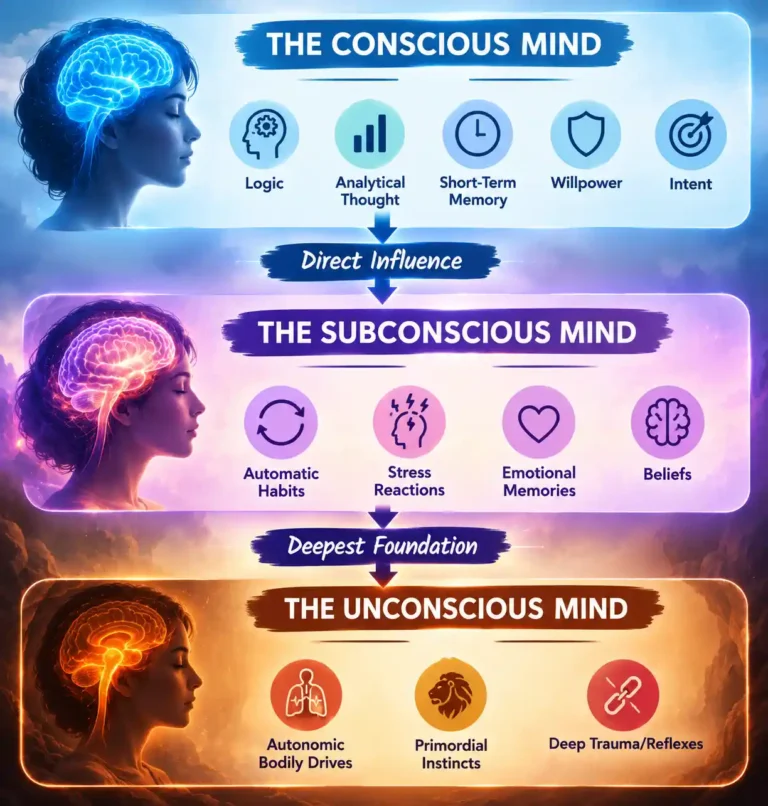
To understand why daily stress feels so hard to control, it helps to examine how the human mind processes information, stores memories, and forms habits. The mind operates across three distinct levels: the conscious, the subconscious, and the unconscious.
1. The Conscious Mind
The conscious mind is the logical, analytical part of your brain that is active right now as you read these words. It is what you use to make deliberate decisions, solve math problems, balance a budget, or set goals. When you say to yourself, “I need to stop worrying about this situation,” that thought is coming from your conscious mind. While powerful in its ability to plan and analyze, the conscious mind has limited processing capacity and drains quickly when tired.
2. The Subconscious Mind
The subconscious mind is the vast, high-speed underlying operating system that runs just below your conscious awareness. It stores your recent memories, behavioral habits, and emotional patterns. Crucially, it manages your automatic emotional responses.
When you encounter a stressful scenario—such as a difficult email, a financial worry, or an argument—your subconscious mind instantly scans its database of past experiences. If it recognizes a pattern of discomfort, it triggers an immediate emotional stress response before your conscious mind even has time to analyze the situation.
3. The Unconscious Mind
The unconscious mind is the deepest, most primal reservoir of the human psyche. It operates entirely beyond conscious access and holds deep-seated biological instincts, autonomic reflexes (such as heart rate, digestion, and the fight-or-flight response), and deeply buried emotional experiences or trauma.
When long-term stress signals reach the unconscious level, the body enters a state of chronic nervous system arousal, causing physical symptoms like muscle tightness, shallow breathing, and digestive disruption.
Why Willpower and Positive Thinking Fail Against Deep Stress
Most popular self-help strategies rely almost entirely on conscious willpower. You try to replace anxious thoughts with positive affirmations, or you force yourself to ignore feelings of tension. However, relying strictly on willpower creates a deep internal conflict known as mental friction.
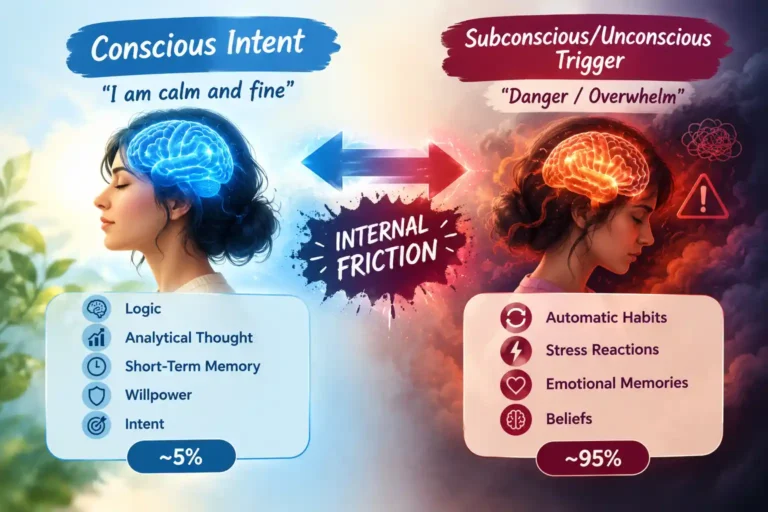
When your conscious intent conflicts with your subconscious and unconscious conditioning, the deeper levels of the mind almost always win. Willpower acts like a muscle: it gets fatigued as the day progresses. When your conscious energy is depleted by evening, your mind naturally defaults back to its underlying subconscious programming. This is why overthinking and anxiety often peak at night when you are trying to sleep.
The Hidden Physiology of Overthinking
Overthinking is rarely just a mental issue; it is a full-body physiological response driven by the unconscious regulation of your nervous system. When your deeper mind perceives continuous daily pressures, it interprets them as a signal that you are under constant threat, activating the body’s sympathetic nervous system (for a deeper look into how this works, see the Harvard Health guide on the chronic stress response).
The Chronic Stress Cycle
Perceived Threat: A daily stressor triggers an automatic subconscious alarm.
Unconscious Hormonal Cascade: The adrenal glands automatically release stress hormones, including cortisol and adrenaline.
Physical Changes: Heart rate increases, muscles tighten, breathing becomes shallow, and digestion slows down.
Mental Hyper-Vigilance: The brain enters a defensive state, actively scanning for more potential problems. This hyper-vigilance presents as continuous, uncontrollable overthinking.
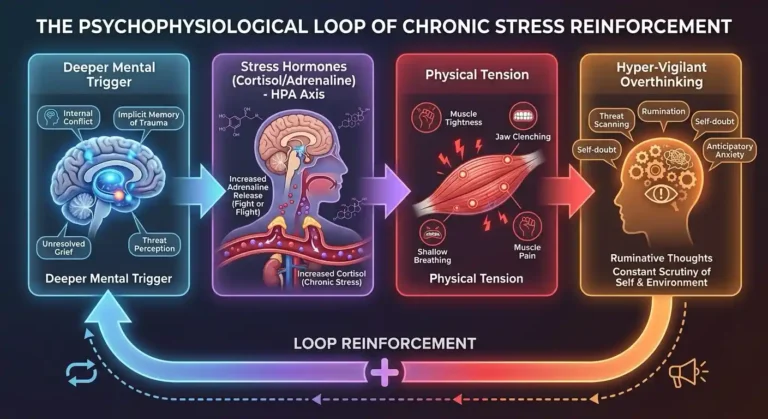
Breaking this cycle requires an approach that calms the nervous system and updates how the mind interprets daily events.
Core Benefits of Subconscious Mind Programming for Stress Relief
Subconscious mind programming is a practical, structured process of identifying and updating the automatic thought loops and emotional triggers that keep you stuck in stress. By reconditioning automatic responses, you can easily release emotional tension stored in your body and mind:
Stop Overthinking Automatically: Intercepts repetitive, negative thought loops before they spiral into full-blown anxiety.
Rapid Physical De-Escalation: Teaches your nervous system how to quickly return to a parasympathetic (rest-and-digest) state after encountering a stressor.
Releasing Stored Emotional Baggage: Clears underlying emotional tension linked to past experiences, allowing you to handle new challenges with a clean slate.
Restoring Sleep Quality: Calms the nocturnal hyper-vigilance that keeps your brain awake, facilitating deeper, more restorative rest.
Improving Focus and Mental Energy: Reduces cognitive overload, freeing up mental bandwidth for creativity, decision-making, and presence.
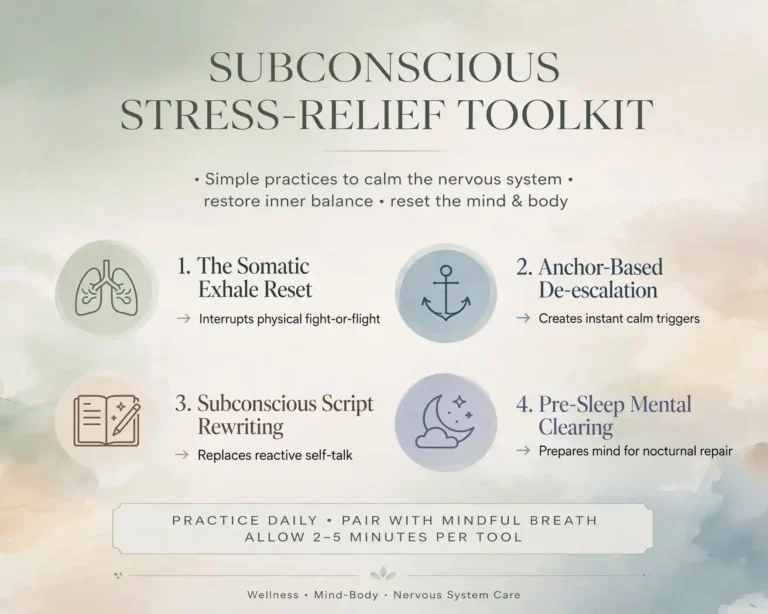
4 Practical Subconscious Techniques You Can Practice Today
Reconditioning your mind does not require hours of meditation or complex theoretical study. Simple, consistent daily practices can yield immediate structural shifts in how your brain handles stress. Applying these simple self healing techniques for 5 to 10 minutes a day creates lasting neural changes.
1. The Somatic Exhale Reset
The subconscious and unconscious mind respond far more quickly to physical signals than to abstract logic. When you notice stress building, use your breath to send a direct safety signal to your nervous system:
Inhale quietly through your nose for a count of 4 seconds.
Hold the breath gently for a count of 4 seconds.
Exhale slowly through slightly parted lips for a count of 8 seconds, making a soft “whoosh” sound.
Repeat this cycle 4 to 5 times.
Extending the exhale directly stimulates the vagus nerve, telling your deeper mind that the immediate threat has passed and it is safe to turn off the alarm system. To learn more about how physical anchors regulate nervous system arousal, explore the Psychology Today overview on vagus nerve stimulation.
2. Creating a Physical Calm Anchor
An “anchor” is a physical touch or cue paired with a deep state of relaxation. Over time, your subconscious associates the touch with the emotional state:
Choose a comfortable time when you feel naturally relaxed and calm (such as right after a warm bath or during a peaceful moment at home).
Gently press your right thumb and index finger together.
While holding this touch, focus deeply on the feeling of warmth, safety, and physical ease in your body.
Practice this pairing daily for two weeks.
Once established, pressing those fingers together during a stressful workday will trigger your subconscious to recall that baseline of calm.
3. Rewriting Subconscious Self-Talk
Your subconscious mind accepts the language you use as absolute truth. When you repeatedly say “I can’t handle this” or “Everything is going wrong,” your subconscious accepts these statements as commands and generates matching emotional tension.
Step 1 (Awareness): Catch yourself when you speak in absolute negative terms during stressful moments.
Step 2 (Pause): Take one slow breath to create a gap between the trigger and your response.
Step 3 (Re-frame): Replace the statement with a grounded, supportive command. Instead of “I am losing control,”shift to: “My body is experiencing temporary stress, but I am safe, calm, and capable of handling this step-by-step.”
4. The Pre-Sleep Mental Clearing Routine
During the 15 to 20 minutes right before you fall asleep, your brain naturally transitions into Alpha and Theta brainwave states. In these states, the barrier between the conscious and subconscious mind thins, making your mind highly open to positive suggestion.
- Avoid Distractions: Turn off news and social media at least 30 minutes before bed to prevent feeding stressful inputs into your deeper mind right before sleep.
- Mental Inventory: As you lay in bed, visualize mentally placing all unresolved problems, tasks, and worries into a secure box outside your bedroom door.
- Focus on Resolution: Repeat a simple calming phrase as you drift off: “My day is complete. My mind is clear. I rest and restore completely.”
Comparing Stress Management Approaches
Understanding how different self-healing methodologies function helps you choose the right approach for your needs:
| Feature / Method | Traditional Willpower | Standard Relaxation Techniques | Subconscious Mind Programming |
| Primary Level Targeted | Conscious Mind (~5%) | Physical Body / Nervous System | Subconscious & Unconscious Mind (~95%) |
| Primary Mechanism | Forcing thoughts, suppression | Temporary symptom relief | Rewiring root-cause triggers |
| Speed of Relief | Temporary (requires constant effort) | Immediate (lasts short duration) | Immediate physical calm + long-term change |
| Effort Required | High mental energy | Low to Moderate | Low (focuses on consistency) |
| Addresses Root Triggers | No | Partially | Yes |
Frequently Asked Questions
Do I need prior experience with hypnosis or psychology to practice this?
No prior experience is necessary. The techniques used in subconscious mind programming are based on natural processes that your brain already uses every day. With straightforward guidance, anyone can learn to direct these processes intentionally.
How long does it take to see noticeable changes in my stress levels?
Most people experience a noticeable physical drop in tension and a sensation of mental clarity during their very first practice session. For long-term shifts in chronic overthinking or deep-seated emotional habits, practicing simple daily anchors for 14 to 21 days helps lock in the new neural pathways.
Can subconscious programming help with physical symptoms of stress like muscle tightness?
Yes. Because the subconscious and unconscious levels directly control your autonomic nervous system, releasing mental tension automatically triggers a physical relaxation response. As your deeper mind steps down from hyper-vigilance, muscles relax, breathing deepens, and heart-rate variability improves.
Summary & Next Steps
Living in a constant state of stress, anxiety, and overthinking is not an inevitable part of modern life. When you understand that stress is maintained by automatic subconscious and unconscious routines, you no longer have to waste energy fighting your own thoughts.
By applying simple somatic resets, physical anchoring, conscious re-framing, and pre-sleep mind clearing, you can update your underlying mental operating system. With consistent practice, calm authority becomes your default response to daily challenges.
Take the Next Step Toward Inner Peace
Explore Our Programmes: Learn more about immersive, guided group sessions designed to clear deep subconscious blocks.
Practice the Tools: Commit to using the Somatic Exhale Reset and Pre-Sleep Routine daily for the next 7 days.
Connect With Us: Fill the form at our contact us page, or reach out to us at +91-9896075664..